
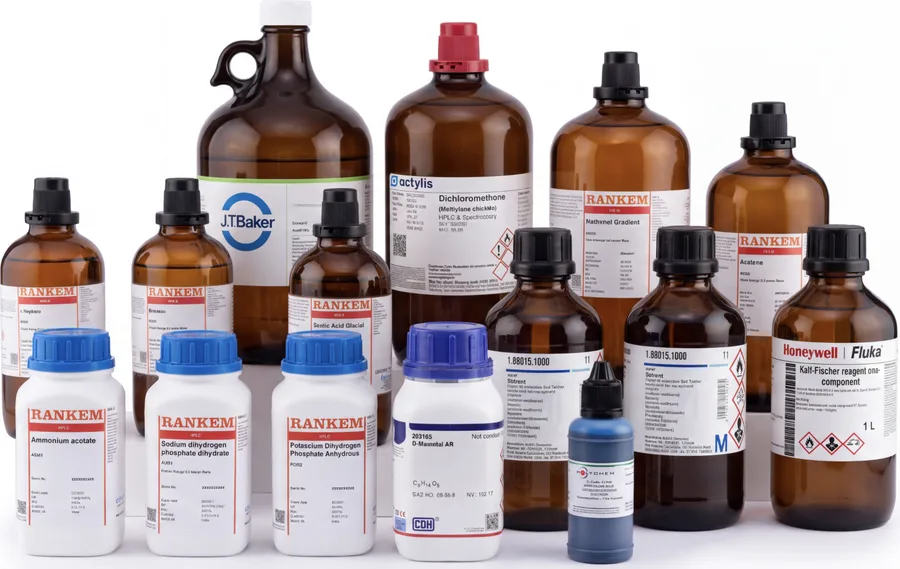
Understand the key differences between laboratory reagent, analytical reagent, and HPLC grade chemicals and when to use each.
Introduction
When purchasing laboratory chemicals, you'll encounter grades like LR, AR, and HPLC. These designations aren't just marketing terms — they define precise levels of purity that determine whether a chemical is suitable for your specific application. Using the wrong grade can compromise your results, waste reagents, and in regulated labs, trigger audit failures.
What is LR Grade (Laboratory Reagent Grade)?
LR (Laboratory Reagent) grade chemicals are suitable for general laboratory work where high purity is not critical. These chemicals meet minimum purity requirements but may contain trace impurities that don't affect most routine procedures.
Typical purity: 95–99% depending on the compound.
Best for: General cleaning, educational labs, non-critical preparations, qualitative analysis.
Not suitable for: Quantitative analysis, instrument calibration, HPLC work, or pharmaceutical QC.
What is AR Grade (Analytical Reagent Grade)?
AR (Analytical Reagent) grade chemicals are manufactured to meet the requirements for analytical work. They are tested against published standards (ACS, IP, BP, etc.) and contain certified levels of impurities.
Typical purity: 99–99.9% with well-characterized impurity profiles.
Best for: Quantitative analysis, titrimetry, gravimetry, AAS, standard preparation, and most laboratory analyses.
Key advantage: Every batch comes with a detailed Certificate of Analysis (COA) listing impurity levels — critical for traceability in regulated labs.
What is HPLC Grade?
HPLC (High-Performance Liquid Chromatography) grade chemicals — primarily solvents — are specifically manufactured for use in chromatographic systems. They have exceptionally low UV absorbance, minimal particulate matter, and extremely tight impurity control to protect expensive HPLC columns and ensure baseline stability.
Typical purity: ≥99.9% with UV cutoff specifications.
Best for: HPLC analysis, UHPLC, LC-MS/MS, gradient elution, optical detection systems.
Key specifications: UV absorbance at 210nm, 254nm, and 280nm; water content; residue on evaporation; particulate matter.
Grade Comparison Table
| Property | LR | AR | HPLC |
|---|---|---|---|
| Purity | 95–99% | 99–99.9% | ≥99.9% |
| COA provided | Basic | Detailed | Comprehensive |
| UV absorbance tested | No | Sometimes | Yes |
| Suitable for HPLC | No | No | Yes |
| Price (relative) | Low | Medium | High |
Which Grade Should You Choose?
The choice depends on your application:
- Routine lab cleaning / general synthesis: LR grade is sufficient and cost-effective.
- Quantitative analysis, titrimetry, standard preparation: Use AR grade.
- HPLC, UHPLC, LC-MS analysis: Always use HPLC grade solvents to protect your column and ensure accurate results.
- Pharmaceutical QC, reference standard preparation: Use AR or higher, with COA and full traceability.
Common Mistakes to Avoid
One of the most frequent mistakes in laboratory settings is using LR grade solvents in HPLC systems. Even trace UV-absorbing impurities in LR solvents will cause baseline drift, ghost peaks, and poor reproducibility. The cost saving on solvents is quickly wiped out by column damage and invalid results.
Similarly, using HPLC grade chemicals for general cleaning or non-critical preparations is unnecessary expenditure.
Authorized Brands Available at Upashna Enterprises
We supply all grades from Merck, Sigma Aldrich, Rankem, JT Baker, CDH, Spectrochem, Loba Chemie, and SRL — with genuine COAs and full documentation for every batch.
Conclusion
Understanding chemical grades is fundamental to laboratory quality. The right grade ensures accurate results, protects your instruments, and maintains compliance with regulatory standards. When in doubt, always consult your SOP or contact our technical team for guidance on grade selection.