
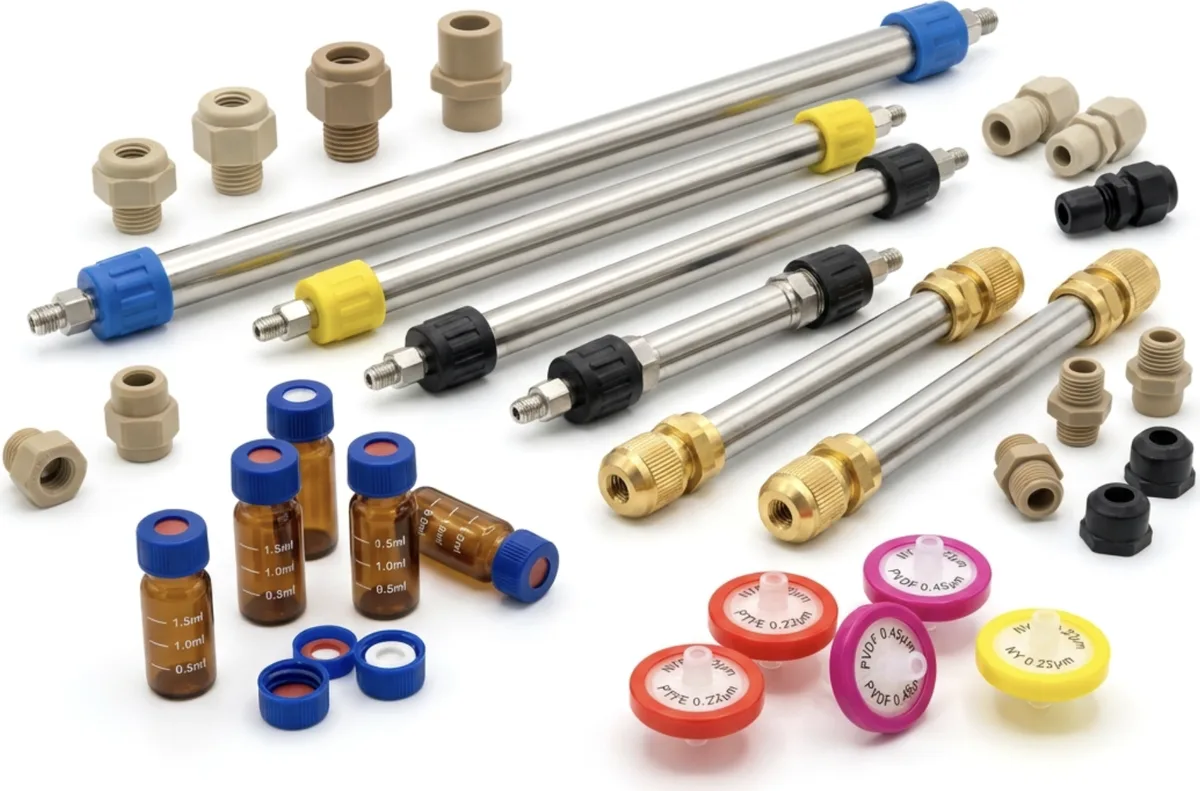
A practical guide to choosing between C8 and C18 reversed-phase HPLC columns for your separation needs.
The Most Common Question in Chromatography
If there's one question our technical team gets asked more often than any other, it's this: "Should I use a C8 or C18 column for my HPLC method?" It sounds simple, but the answer depends on your analyte's chemistry, your mobile phase conditions, and your separation goals.
Understanding Reversed-Phase HPLC
Both C8 and C18 are reversed-phase stationary phases — meaning the stationary phase is non-polar (hydrophobic) and the mobile phase is polar (aqueous-organic). Analytes separate based on their hydrophobicity: more hydrophobic compounds elute later.
C18 (Octadecylsilane, ODS) Columns
C18 columns have an 18-carbon alkyl chain bonded to silica. They are the most widely used HPLC columns globally and are the default choice for reversed-phase work.
Advantages:
- High retention for hydrophobic analytes
- Excellent selectivity for a wide range of compounds
- Most USP and BP methods are validated on C18
- Wide selection of makes, particle sizes, and dimensions
Best for: Drugs with moderate to high hydrophobicity, most pharmaceutical APIs and impurities, most pharmacopoeial methods.
C8 (Octylsilane) Columns
C8 columns have an 8-carbon alkyl chain — shorter than C18. This makes them less hydrophobic and provides lower retention for hydrophobic analytes.
Advantages:
- Faster elution of very hydrophobic compounds — avoids excessively long run times
- Better for hydrophilic or moderately hydrophobic analytes that would elute near the void volume on C18
- Sometimes provides different selectivity, useful for resolving co-eluting peaks
Best for: Basic drugs, proteins/peptides (short-chain preferred), analytes that are over-retained on C18 even with high organic modifier.
When C8 Outperforms C18
The main reason to switch from C18 to C8 is when your analyte is so hydrophobic that even at 90–95% organic modifier, it's still too retained. A C8 column will elute it at a more workable mobile phase composition.
Conversely, if your analyte elutes too close to the void volume on C18, you need a more retentive column — not less.
Practical Decision Guide
| Situation | Recommended |
|---|---|
| Starting a new method, unknown selectivity | C18 (universal first choice) |
| Analyte very hydrophobic, elutes late even at 90% organic | C8 (less retention) |
| Need to match a pharmacopoeial method | Check specification — usually C18 |
| Separation of basic drugs at low pH | C8 or end-capped C18 |
| Very fast analysis needed | Short C8 or C18 2.1×50mm UHPLC |
Other Variables That Matter More Than C8 vs C18
Particle size (5μm vs 3μm vs 1.8μm sub-2μm), pore size (80Å vs 120Å for large molecules), end-capping quality, and pH stability often have a bigger impact on separation than the carbon chain length alone. Always test 2–3 column chemistries during method development.
Brands Available at Upashna Enterprises
We supply Merck Lichrospher, Sigma Aldrich Supelco Ascentis, and Thermo Fisher Hypersil Gold series in both C8 and C18 — in multiple particle sizes and dimensions. Contact us for column selection guidance.